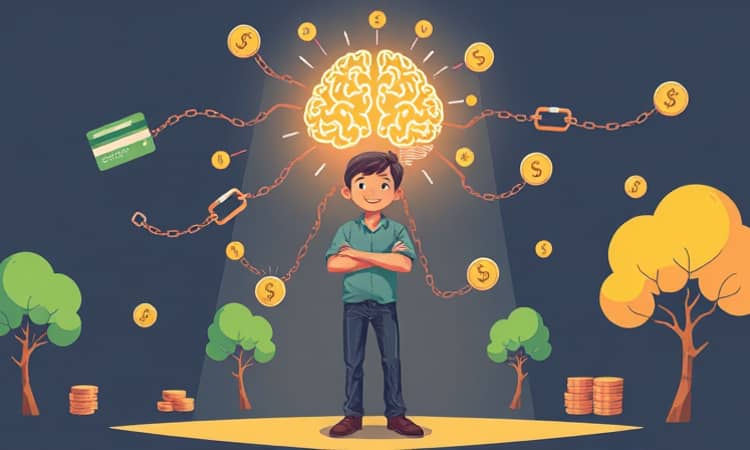
Credit card debt is more than a financial issue; it's a psychological labyrinth that millions navigate daily.
With total U.S. credit card debt soaring past a trillion dollars, the scale is staggering and often overwhelming.
This article aims to unravel the complex psychological mechanisms behind debt and provide a path to liberation.
Understanding the mind's role in debt can empower you to break free and reclaim control over your finances.
The Sobering Reality of Credit Card Debt
Before diving into psychology, grasp the magnitude of this widespread challenge.
Recent data reveals alarming trends that underscore the urgency of addressing credit card debt.
- Total U.S. credit card debt exceeded $1.17 trillion in early 2026, with projections to reach $1.18 trillion by year's end.
- Average credit card debt among cardholders with unpaid balances was $7,886 in Q3 2025, up from $7,673 in Q1 2024.
- Delinquency rates rose to 3.6% in Q4 2024, though they dipped to 2.98% in Q3 2025, indicating fluctuating payment behaviors.
- 22% of credit card users only make minimum payments, and 70% expect to carry a balance, highlighting persistent debt cycles.
These statistics paint a vivid picture of a crisis affecting countless lives.
77% of workers identify credit card debt as a major problem, reflecting deep-seated concerns.
How Your Brain Fuels Debt
Neuroscience reveals that credit cards tap into primal reward systems, making spending feel effortless.
Credit cards activate the reward center of the brain, which drives greater purchasing behavior and reduces payment pain.
This operates through two key mechanisms that explain why debt accumulates so easily.
- The "Release the Brakes" hypothesis: Credit cards lower psychological friction by minimizing the immediate pain of payment.
- The "Step on the Gas" hypothesis: They motivate spending by activating reward networks, potentially leading to addictive habits.
Temporal discounting plays a role, where people prioritize present satisfaction over future debt consequences.
This present bias in financial decision-making skews our ability to evaluate long-term happiness accurately.
Credit usage often correlates with available limits, showing how psychology influences spending patterns.
The Mental Health Toll of Debt
Debt doesn't just strain wallets; it severely impacts mental well-being and life satisfaction.
Research confirms that household debt is detrimental to mental health, leading to increased anxiety and medication use.
Among those with payment difficulties, 20.8% report feelings of distress, and 17.9% use mental health medications.
This table illustrates the stark disparities in health outcomes based on debt status.
Subjective well-being is often undermined, with student loans showing the strongest negative association with life satisfaction.
64% of psychology graduate students report that financial concerns interfere with optimal functioning, a sentiment shared by many.
Breaking the Cycle: Understanding Causality
The relationship between debt and mental health is bidirectional, creating a self-reinforcing loop.
Payment difficulties can lead to mental health issues, and pre-existing mental problems may exacerbate debt struggles.
- Mental problems → payment difficulties: Earlier psychopharmaca consumption predicts future financial challenges.
- Payment difficulties → mental problems: Debt correlates with subsequent anxiety and increased medication use.
It's crucial to recognize this bidirectional causality in debt cycles to address both aspects effectively.
Confounding factors, such as anxious personalities, complicate causation, but awareness is the first step toward intervention.
Childhood attitudes toward debt and family financial structures often shape adult behaviors, adding layers to the psychological puzzle.
The Economic Landscape and Credit Market
External factors, like interest rates and lending trends, influence how debt accumulates and is managed.
Lenders are cautiously expanding credit access while implementing strategies to mitigate delinquency risks in uncertain times.
Average credit card interest rates were 23.79% recently, down from peaks, following Federal Reserve rate cuts.
- Credit card balances grew at double-digit rates in 2022-2023 but have moderated due to economic uncertainty.
- Consumers are navigating this environment with disciplined lending standards, yet debt remains a persistent issue.
Understanding this context helps in crafting realistic strategies to overcome debt challenges.
Practical Steps to Regain Control
Overcoming credit card debt requires a blend of psychological insight and actionable strategies.
Start by acknowledging the minimum payment trap that keeps 22% of users in perpetual debt cycles.
Here are evidence-based interventions to break free and build financial resilience.
- Increase awareness of psychological triggers: Monitor spending when credit limits rise to avoid the credit limit psychology effect.
- Set clear financial goals: Prioritize paying off high-interest debt first to reduce long-term costs and anxiety.
- Use behavioral nudges: Automate savings and debt payments to counteract present bias and temporal discounting.
- Seek support: Engage in financial counseling or peer groups to address the emotional aspects of debt.
- Practice mindfulness: Reduce impulsive purchases by pausing before spending, leveraging awareness of reward system activation.
These steps empower you to dismantle debt patterns rooted in psychology.
Empowering Yourself to Overcome Debt
Taking control of your financial future starts with understanding and action.
Recognize that debt is not a personal failure but a common challenge with psychological underpinnings.
Focus on building healthy financial habits that align with long-term well-being rather than short-term gratification.
- Educate yourself on personal finance: Knowledge reduces anxiety and improves decision-making.
- Create a budget that accounts for psychological spending tendencies, such as setting aside funds for treats to avoid deprivation.
- Celebrate small victories: Paying off a card or reducing balances boosts morale and reinforces positive behavior.
This journey is about more than numbers; it's about reclaiming peace of mind and life satisfaction.
With perseverance and the right tools, you can transform your relationship with money and debt.
Embrace the process, and remember that every step forward is a victory against the psychological chains of debt.
References
- https://pmc.ncbi.nlm.nih.gov/articles/PMC6533593/
- https://use.expensify.com/blog/credit-card-statistics
- https://spssi.onlinelibrary.wiley.com/doi/10.1111/sipr.12074
- https://newsroom.transunion.com/2026-consumer-credit-forecast/
- https://mitsloan.mit.edu/experts/how-credit-cards-activate-reward-center-our-brains-and-drive-spending
- https://www.lendingtree.com/credit-cards/study/credit-card-debt-statistics/
- https://www.bankrate.com/credit-cards/news/new-credit-card-debt-research/
- https://www.federalreserve.gov/releases/g19/current/
- https://www.foxbusiness.com/personal-finance/credit-scores-plummet-across-multiple-states-creating-perfect-storm-american-wallets-expert-says
- https://fred.stlouisfed.org/series/CCLACBW027SBOG
- https://greenwaldresearch.com/survey-majority-of-workers-worry-about-credit-card-debt/
- https://talkerresearch.com/research-shows-many-americans-plan-to-carry-holiday-credit-card-debt-for-months/
- https://www.apa.org/gradpsych/2013/01/debt